
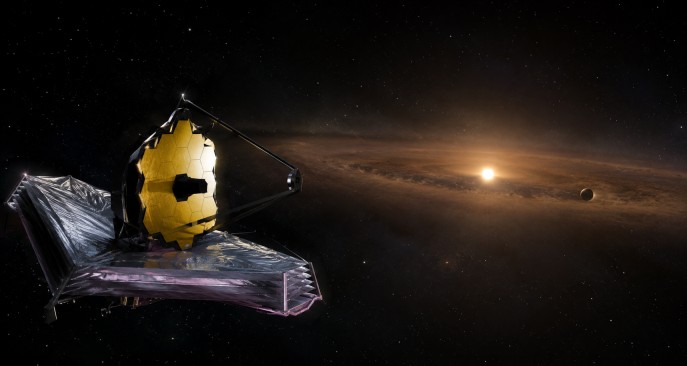
Astronomers have achieved a significant breakthrough using NASA’s James Webb Space Telescope, uncovering an exoplanet known as Beta Pictoris d. This newly discovered planet adds to the intrigue of the Beta Pictoris system by becoming its third recognized giant planet. Unlike its predecessors, Beta Pictoris d was not visually imaged but was instead revealed through the unique chemical signature of its atmosphere. This unexpected discovery occurred while scientists were employing the Webb’s Near-Infrared Spectrograph (NIRSpec) to investigate another planet within the same stellar neighborhood.
The identification of Beta Pictoris d was confirmed after researchers meticulously analyzed its atmospheric composition and movement, detecting the presence of carbon monoxide, water vapor, and methane. These findings verified that the object is indeed a giant planet residing within the system’s luminous debris disk, a feature that had previously obscured it from traditional imaging techniques. This discovery is especially noteworthy as it marks the first instance of an exoplanet being primarily detected through moderate-resolution spectroscopy, heralding a novel method for identifying planets within dusty environments.
Situated approximately 63 light-years from Earth, the Beta Pictoris system, which is around 23 million years old, serves as a vital research ground for understanding the formation and evolution of planetary systems. Beta Pictoris d is estimated to have a mass at least twice that of Jupiter and orbits its parent star at a distance akin to Neptune’s position in our solar system. This discovery not only enriches the understanding of this particular system but also showcases the potential of spectroscopy in uncovering celestial bodies that lie hidden within complex cosmic settings.
The implications of this discovery extend beyond the Beta Pictoris system. Researchers are optimistic that this method of planet detection could significantly enhance future efforts to locate exoplanets across the Milky Way. By leveraging the capabilities of moderate-resolution spectroscopy, scientists can now explore regions once deemed too challenging due to the presence of bright debris or other interfering materials. This advancement represents a promising new frontier in the ongoing quest to map the vast expanse of our galaxy.