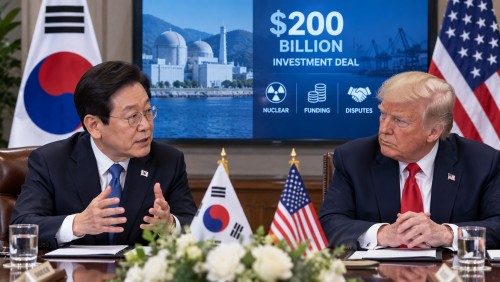
Ongoing negotiations between South Korea and the United States over a major $200 billion investment package have hit significant roadblocks, creating uncertainty around future nuclear projects and financial commitments. This impasse could delay or alter the scope of planned infrastructure and energy developments, potentially affecting the economic and strategic interests of both nations.
The core of the disagreement revolves around nuclear power projects, with South Korea aiming to invest significantly in U.S. infrastructure, including the construction of eight nuclear reactors. While plans include six reactors based on Westinghouse’s AP1000 design, differences have emerged over the inclusion of South Korea’s APR1400 technology. U.S. officials and Westinghouse reportedly oppose incorporating the Korean-designed reactors, complicating the finalization of the nuclear deal.
Further complicating the negotiations are financial disagreements, particularly regarding the funding schedules and the distribution of investment returns and risks. The U.S. has requested South Korea to contribute over $9 billion by the end of the year, but Seoul prefers a more gradual investment approach, starting in 2026 with increased contributions from 2027. This discrepancy raises concerns about project viability and financial stability.
Ownership stakes in Westinghouse are another contentious point. South Korea seeks a 15% to 20% stake with voting rights and a board seat, while Westinghouse wants to limit Seoul’s ownership to below 10%. This ownership struggle adds another layer of complexity to the negotiations, as both sides work to balance control with collaborative partnership.
Additionally, South Korea is considering participation in a U.S. project related to the processing of spent nuclear fuel and a proposed Alaska liquefied natural gas project. However, concerns over construction costs and long-term returns pose potential hurdles to these initiatives.
Despite these challenges, both governments remain engaged in discussions to resolve these issues. The South Korean Industry Ministry has stated that the specifics of the projects, funding structures, and investment arrangements are still under negotiation, indicating that a resolution may yet be reached if both sides can find common ground.