
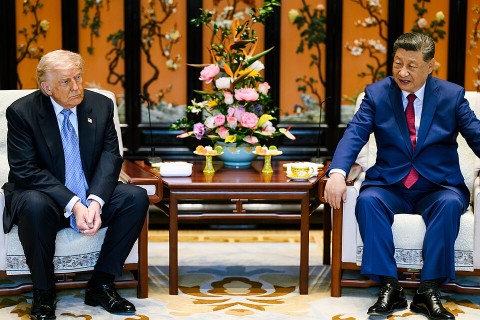
China has issued a cautionary message to the United States regarding the handling of Taiwan-related matters following an announcement by former U.S. President Donald Trump about his intent to communicate with Taiwan’s leader, Lai Ching-te. The prospect of direct dialogue between a U.S. president and the president of Taiwan is particularly delicate for Beijing, which views Taiwan as part of its territory and opposes any form of official engagement by foreign governments with Taipei’s leadership.
Beijing perceives Taiwan as a rebellious province that should ultimately be integrated with the mainland, using force if deemed necessary. The Chinese government consistently opposes any actions by foreign nations that imply recognition of Taiwan as an independent state. High-level diplomatic interactions with Taiwan often provoke criticism from China, as they are seen as sending inappropriate signals to those advocating for Taiwan’s independence and as meddling in China’s internal affairs.
The situation concerning Taiwan has become increasingly tense in recent years. In 2022, China conducted extensive military drills around Taiwan after a high-ranking U.S. official visited the island. Furthermore, Beijing has frequently reacted with hostility to American arms sales to Taiwan and expressions of political support. Despite China’s stance, Taiwan identifies itself as a self-governing democracy, officially known as the Republic of China, and its government denies Beijing’s claims of sovereignty, asserting the right of its citizens to elect their leaders and establish international relationships.
The United States maintains a “One China” policy, which involves diplomatic recognition of Beijing while sustaining unofficial relations with Taiwan. Under the Taiwan Relations Act, the U.S. also provides defensive arms to Taiwan. A previous instance of direct contact occurred in 2016 when Trump spoke with then-Taiwanese President Tsai Ing-wen, a move that drew Chinese ire. Another call between Trump and Lai could exacerbate already strained U.S.-China ties and might lead to new military maneuvers by China near Taiwan.