
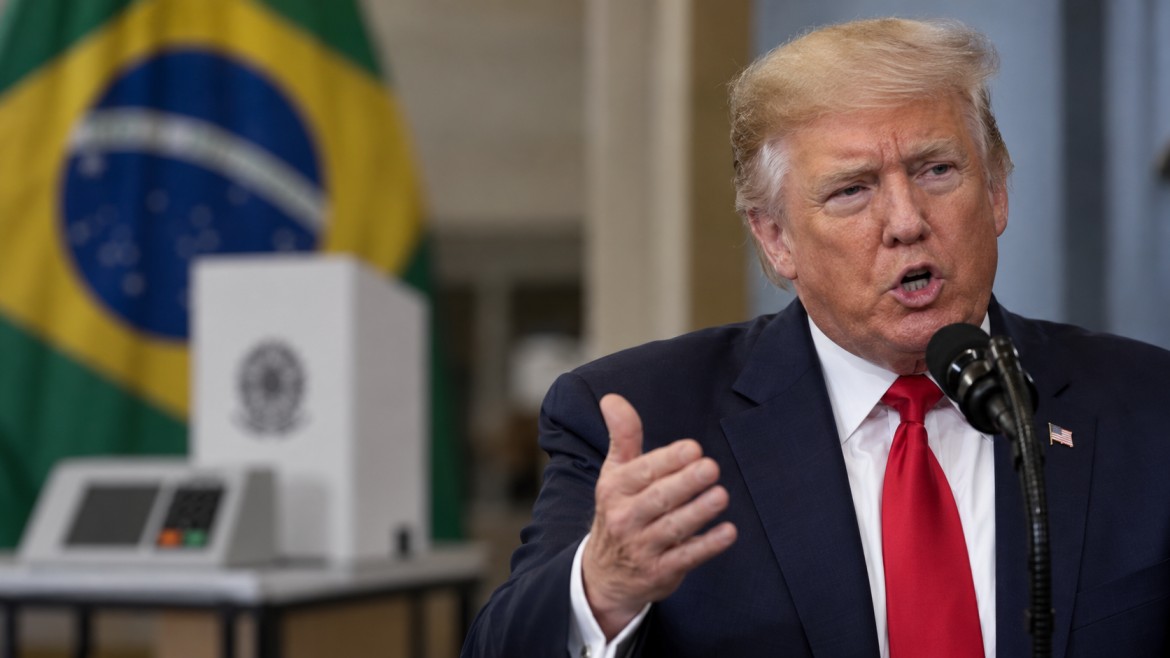
In a move likely to strain relations between the United States and Brazil, former President Donald Trump has cast doubt on the integrity of Brazil’s presidential election, alleging without evidence that it was “rigged.” Trump’s remarks came after leftist President Luiz Inácio Lula da Silva secured a fourth term, defeating right-wing challenger Flávio Bolsonaro.
Speaking at Joint Base Andrews in Maryland on October 26, Trump criticized the election outcome as a negative reflection on Brazil’s democratic process. Although he did not provide any evidence for his claims, Trump emphasized that elections should be beyond dispute, while distancing himself from any responsibility for the election’s outcome, citing his focus on U.S. governance.
Throughout the election campaign, Trump refrained from formally endorsing any candidate but had previously shown support for former Brazilian President Jair Bolsonaro, aligning with the larger Make America Great Again (MAGA) movement. In reaction to Lula’s victory, Bolsonaro refused to concede and called for the annulment of the election results, though a Brazilian official expressed confidence that Lula’s victory would be recognized by Washington, citing the difficulty of disputing the results.
Some of Trump’s allies have advocated for a stronger stance against Brazil, suggesting actions like suspending diplomatic relations. Despite this, Lula’s victory solidifies his political standing as he prepares to navigate his presidency amid ongoing tensions with the Trump administration over trade and other policy issues.
Following his win, Lula addressed supporters in São Paulo, celebrating the moment as historic for Brazilian democracy. He assured that dictatorship and fascism would not return to the country, and emphasized the significance of democratic institutions and political stability.
The controversy surrounding the election highlights potential diplomatic tensions as Lula enters his new term. Both the U.S. and Brazilian governments will need to manage their differences over trade, diplomacy, and regional politics in the upcoming years.